Emma Reed
March 8, 2026

Peptide Tracking 101: How to Log Carefully, Spot Patterns, and Stay Safety-First
Peptides are everywhere in modern health conversations. You see them in podcasts, social media clips, gym forums, and long comment threads where everyone sounds confident and almost no one cites solid context. That combination—high interest and mixed-quality information—is exactly why careful tracking matters.
A peptide tracker is not a magic health tool. It will not diagnose anything, prescribe anything, or guarantee outcomes. What it can do, when used correctly, is help you keep organized records: what you used, when you used it, how you felt, what changed, and what did not. In short, it turns vague memory into structured notes.
This article is a practical guide for educational logging. It is written for people who want better records, fewer guess-based decisions, and more honest conversations with licensed clinicians. It is not a treatment guide, and it does not include dosing instructions.
Why tracking peptides is harder than people expect
At first glance, tracking seems simple: open an app, enter a few notes, done. In practice, most people run into the same five problems.
1) Inconsistent entries
Many users start strong and then skip logs when life gets busy. Missing days create blind spots, and blind spots make patterns look cleaner than they really are.
2) Confirmation bias
If you expect a positive change, you are more likely to notice good days and discount bad days. If you expect side effects, the opposite can happen. Good logs reduce this bias by forcing neutral structure.
3) Too many changing variables
Sleep, stress, caffeine, workouts, hydration, travel, and illness can all affect how you feel. If multiple factors shift at once, it is difficult to link any change to one cause.
4) Recall errors
Memory is noisy. By evening, details from the morning can blur. By next week, they often become stories rather than facts. Time-stamped logging protects against this drift.
5) Poor safety documentation
People often track “effects” but ignore warning signals, stop conditions, or context that matters for medical review. A safe tracker design gives these items dedicated fields.
What to track (and what to ignore)
The goal is clarity, not volume. You do not need twenty fields per day. You need the right fields every day.
Core fields
- Date and local time
- Product label name exactly as shown
- Source or batch identifier (if available)
- Administration method category (for record-keeping only)
- Pre-use baseline notes (energy, mood, sleep quality, appetite, symptoms)
- Follow-up notes at consistent time windows (for example: same day, next morning)
- Adverse events or unusual reactions
- Other relevant factors (exercise load, alcohol, travel, poor sleep, illness)
Useful optional fields
- Resting heart rate trend
- Body weight trend
- Subjective stress score (simple 1–5 scale)
- Sleep duration and sleep interruptions
- Notes from clinician conversations
Fields to avoid
- Overly technical metrics you cannot collect consistently
- Speculation presented as fact
- Copy-pasted claims from social media
- Any “guaranteed result” language
Tracking works best when entries are brief, factual, and boring. Boring is good. Boring scales.
Build a repeatable logging routine
A great tracker is less about features and more about routine design. Use a rhythm that fits real life.
Step 1: Pick fixed check-in times
Choose one or two daily windows you can actually keep. Example: morning check-in and evening check-in. Fixed times reduce missing data and improve comparability.
Step 2: Use standard wording
Create short templates: “Sleep quality,” “Energy,” “Mood,” “Any unusual symptoms,” “Major confounders today.” Reusing the same prompts improves data quality.
Step 3: Keep raw notes and summary notes separate
Raw notes capture observations as they happen. Summary notes are your weekly reflection. Mixing both in one field tends to create messy, edited memory.
Step 4: Mark confounder days clearly
If you had jet lag, poor sleep, or acute stress, tag that day. Later pattern reviews become much more realistic when confounders are visible.
Step 5: Review weekly, not constantly
Constant interpretation can lead to overreaction. A weekly review cadence is usually enough to identify broad trends while avoiding noise-driven decisions.
Safety-first logging: practical guardrails
A peptide tracker should include safety guardrails by default. Think of these as friction that prevents reckless behavior.
Guardrail A: Red-flag field
Add a clear “red-flag symptoms” field that is easy to access. If concerning symptoms appear, users should prioritize professional medical care instead of self-experiment escalation.
Guardrail B: Stop-and-review rule
Define a personal rule in advance: if certain warning signs appear, pause logging experiments and consult a licensed clinician. Pre-committing to this rule reduces impulsive decisions.
Guardrail C: No treatment claims in your own notes
Write observations, not conclusions. “Headache after poor sleep” is an observation. “This peptide fixed X condition” is a treatment claim and often not supportable.
Guardrail D: Medication interaction awareness
Keep a simple list of current medications and supplements in your tracker profile. This is useful context for clinical conversations.
Guardrail E: Privacy and data minimization
Health-adjacent logs are sensitive. Use strong account security, avoid unnecessary personal identifiers, and keep exports under your control.
How to read your own data without fooling yourself
People do not usually fail at logging. They fail at interpretation. Here are practical methods that improve signal quality.
Use trend windows, not single days
A single good day means little. Look at 2–4 week windows. Compare averages, not isolated peaks.
Separate “felt better” from “did better”
Subjective feelings matter, but behavior outcomes matter too. Pair mood/energy notes with objective routine markers (sleep duration, consistency, activity). If both move together over time, confidence improves.
Look for lag effects
Some changes appear with delay. Review whether observations cluster one day later, not only same-day.
Treat missing data honestly
Do not backfill from memory unless clearly marked as estimated. Estimated entries are still useful, but they are not equivalent to real-time logs.
Use plain-language confidence levels
When summarizing weekly trends, rate confidence: low, medium, high. Confidence should drop when data are sparse or confounders are heavy.
A simple weekly review format
You can run this in 10–15 minutes every week.
- Completeness check: How many planned entries were completed?
- Context check: Which confounders were present?
- Signal check: Any repeated patterns across multiple days?
- Safety check: Any red flags, unresolved symptoms, or concerns?
- Action check: What will you change in logging quality next week?
Notice what is missing: aggressive conclusions. A weekly review is for pattern awareness and safety, not for bold claims.
Common mistakes and better alternatives
Mistake: Logging only on “interesting” days.
Better: Log every planned day, even when nothing notable happens.
Mistake: Changing multiple routines at once.
Better: Stabilize sleep, training, and nutrition as much as possible before evaluating trends.
Mistake: Writing emotional conclusions in the same moment as symptoms.
Better: Capture facts first, interpret later during weekly review.
Mistake: Using tracking to replace professional advice.
Better: Use tracking to improve the quality of professional conversations.
Mistake: Ignoring data security.
Better: Use strong passwords, avoid oversharing exports, and review app privacy settings.
Designing entries for clinician-friendly discussions
Many people eventually want to discuss their log with a clinician. The quality of that conversation depends on data quality.
To make logs clinically useful:
- Keep entries dated and time-stamped
- Use consistent symptom wording
- Note major non-peptide factors (sleep debt, infection, stress events)
- Avoid self-diagnosis language
- Bring concise summaries plus raw logs
Clinicians generally respond better to organized timelines than to long narratives. A clean tracker can help reduce ambiguity and improve communication.
Minimal tracker template you can copy
Use this as a practical baseline.
Daily check-in
- Date/time:
- Product label name:
- Batch/source note:
- Sleep quality (1–5):
- Energy (1–5):
- Mood (1–5):
- Appetite changes:
- Unusual symptoms:
- Major confounders today:
- Additional notes:
Weekly summary
- Entries completed / planned:
- Most consistent positive observation:
- Most consistent negative observation:
- Red flags this week:
- Confidence in pattern (low/medium/high):
- Questions for clinician:
This template is intentionally simple. Consistency beats complexity.
Final takeaways
A peptide tracker is best used as a disciplined journal, not a decision engine. Your strongest advantage is not volume of data; it is quality and consistency of data.
If you keep records with neutral wording, stable routines, clear safety guardrails, and honest weekly reviews, you gain something genuinely valuable: a more accurate picture of your own experience over time.
That picture can support better decisions, fewer assumptions, and safer conversations with qualified professionals.
No hype. No miracle claims. Just clean logs, better pattern awareness, and a safety-first mindset.
One last practical note on expectations
Tracking is most helpful when expectations are modest. Many weeks will look uneventful. That is not failure; that is reality being measured instead of guessed. If your data show no clear pattern, that is still a useful outcome because it prevents overconfident decisions. Keep the process calm, consistent, and evidence-oriented. In the long run, disciplined records usually outperform memory, online anecdotes, and impulse.
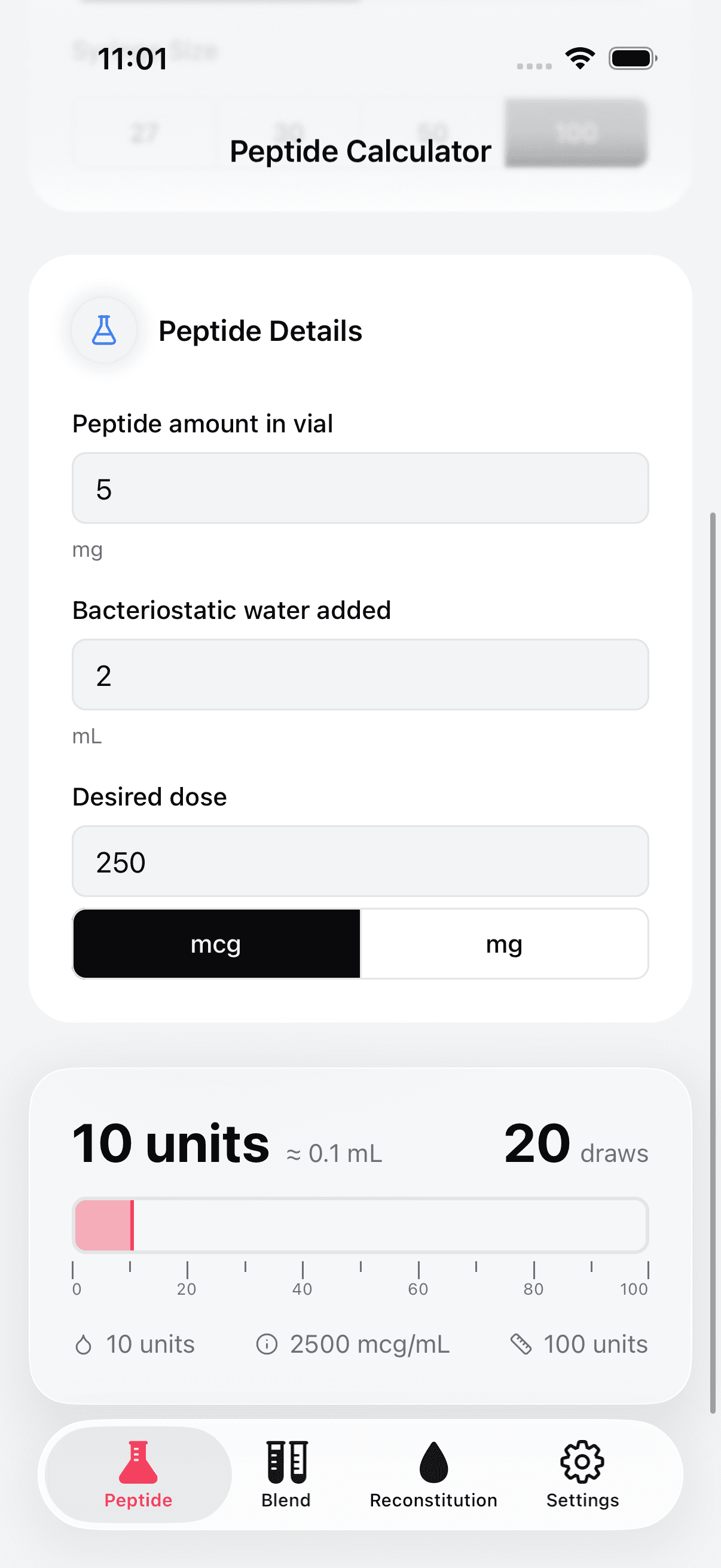
Get accurate peptide doses. Download the calculator today.